
In partnership with:

Get upskilled and recognised by the greatest Real Estate Educational Institutions in the world with the Bayfield Training, University of Cambridge Real Estate Financial Modelling Certificate.
This prestigious online Real Estate course is suitable for modellers new to Real Estate and experienced Real Estate Analysts looking to formalise their skill set. This course will equip you with skills to start building your own financial models and the certificate will give your employers and colleagues reassurance of your expertise.
If you want to enhance your financial modelling skills over an extended period, the Real Estate Financial Modelling Certificate with its three delivery options available is the course for you.
Course Details
Course Delivery Options:
Cohort
Cohort Price: £2500 + VAT
Cohort Duration: 8 weeks
On-Demand
On-Demand Price: £3000 + VAT
Access: 12 Months
On-Demand Plus
On-Demand Plus Price: £3750 + VAT
Access: 18 Months
Study period: 8 hours per module required
CPD hours: 64 hours


Course Dates
2026 Cohort Dates
Cohort 17 – 19th January to 18th March
Cohort 18 – 11th May to 8th July
Cohort 19 – 27th July to 23rd September
Cohort 20 – 5th October to 2nd December
REFMC - Alumni
This online real estate course has been put together exclusively for the Real Estate Financial Modelling certificate, using state of the art digital resources such as animations, video-steps, digital whiteboard and video-interactions as well as the spreadsheets, text based resources and tutor contact you would expect from any of Bayfield Training’s classroom based courses. Assessment is in the form of a guided model build exercise and written model appraisal. Participants benefit from an additional months access to the course platform after submission of the assessment.
What is the difference between the variations of the course:
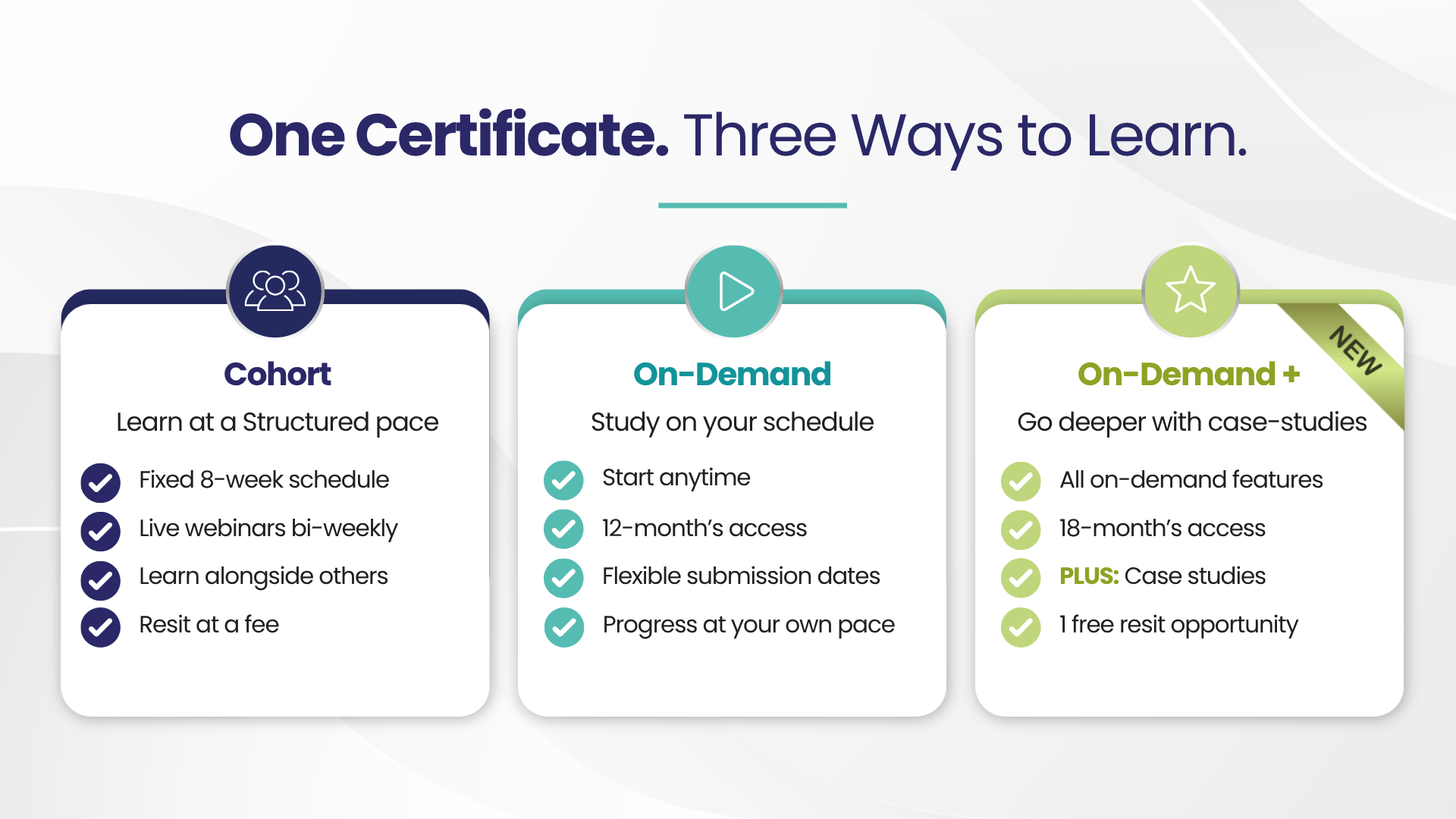
- Cohorts are scheduled on set dates throughout the year, to provide a structured learning experience over eight weeks whilst maintaining flexibility of course working hours in that time period.
- On-Demand allows delegates to start the training at any point in the year, with 12 months access to complete the course. You can take the training as quickly or as slowly as you like.
- On-Demand Plus includes all the benefits of the standard On‑Demand option, plus a free re‑sit of the assessment if required, 18 months of access to the training, and two additional investment case studies Residential and Logistics to broaden your learning across multiple asset classes.
On this course you will:
- Become a confident, technically capable model builder
Learn to construct Real Estate Financial Models entirely from scratch, understanding the logic, structure, and analytical purpose behind each component. By the end, you will be able to build, audit, and adapt models for real‑world investment scenarios. - Learn proven techniques from leading financial modelling experts
Benefit from the experience of practitioners and academics with decades in the industry. You will gain modelling shortcuts, conceptual frameworks, and professional habits that elevate your work beyond basic spreadsheet proficiency. - Use Real Estate Financial Models to make informed investment decisions
Develop the ability to interpret model outputs, test assumptions, run sensitivities, and translate analysis into investment judgement. You will understand how modelling supports acquisition, development, financing, and portfolio strategy. - Master the content through eight structured modules
The curriculum is organised into eight progressive modules, allowing you to build your skills step‑by‑step and fully absorb each concept before moving on. Cohort learners follow an eight‑week guided schedule, while On‑Demand learners can progress at their own pace. - Choose the learning format that fits your schedule and goals Whether you prefer the structure of a scheduled Cohort, the flexibility of On‑Demand, or the extended access and additional case studies offered in On‑Demand Plus, you can tailor your learning experience to your professional commitments and preferred pace.
This course is suitable for:
- Chartered Surveyors
- Asset Managers
- Financial Controllers
- Financial Analysts
- Investment Managers
- Property Managers
- Real Estate Students/Recent Graduates

Module Overview
- Modules 1-3: All the tools, theory and mathematics required to build a financial model.
-
Modules 4-6: Deal ready Real Estate Financial models, incorporating live data, multi-let investment and development projects.
-
Modules 7-8: Project finance, financial risk and investment analytics.
Economic Context
Introduction to Real Estate Asset Modelling and how it relates to and is distinct from Econometric Models.
- Why Real Estate Asset Modelling is important
- Understanding the occupier, asset and development markets and the relevant modelling approaches for each
- Real Estate Sub-Sector Key Performance Indicators
- Introduction to conventional valuations and financial mathematics
- Understanding and minimising errors in Financial Models
Cash Flow Fundamentals
Constructing a financial model from first principles.
- Understanding all the components of a basic cash flow model
- Understand why Corporate Finance Models and Real Estate Models are different
- Financial Model Design
- Making the link between valuations, income mathematics and discounted cash flows
- Internal Rate of Return, Net Present Value,Worth and other metrics
- Features and techniques to aid fast model building
Developing the Cash Flow
Adapting financial models for different periodicities and building rent functions for different rent behaviour.
- Understanding how leases vary with respect to rent over time: Rent Reviews, Break Clauses, Rent Free Periods, Lease Expiries etc.
- Developing the concept of a Rent Function in Excel
- Logic mathematics and Logic functions
- Projecting rent to adapt to different lease contracts and growth patterns
- Alternative solutions to Logic functions
- Comparative analysis of lease structures in different jurisdictions and adapting financial models
Real Estate Data
Understanding the different sources of data, constructing basic time series models and recognising basic patterns.
- Key Property market indicators
- Characteristics and application of key input metrics for Real Estate Appraisals
- Understanding the eight components of Real Estate Price Dynamics
- Awareness of the different sources of data
- Reading and using general property market reports
- Constructing basic time series models and recognising basic patterns
Development Appraisals
Constructing a development appraisal from first principles and understanding development return metrics.
- Understanding the key components of a development project
- Understanding the difference between development and investment appraisals
- Residual Appraisals and Profit Calculations
- Cost orientated cash flows and phased sales
- Cumulative construction cost patterns: incidental, fixed, loaded and S-curve
- Development return metrics and Modified IRRs
Multi-let Cash Flows
Constructing an advanced multi-let cash flow model and learn different techniques to build flexible rent functions.
- Multi-let and portfolio model design principles
- Building complex date functions and date series
- The three multi-let rent projection techniques
- Perpendicular Rent Functions
- Incorporate advanced rent adjustments into the Rent Function
- Incorporate sector and period varying rental growth rates
- Simplifying OPEX and CAPEX projections
- Discounting techniques on complex and volatile cash flows
Project Finance
Constructing a flexible Real Estate Debt Finance model.
- Revision of the Mathematics of amortisation and debt finance
- Basic senior debt models and geared net cash flow
- LTV, IRR and Interest Rate Dynamics
- Flexible term, repayment options and deferred interest
- Loan covenant tests
- Understanding different tranches of debt
- Understanding how complex debt structures impact the returns to different parties
Model Interpretation and Risk Analysis
Learn how to read, analyse and report on real estate financial models.
- Understand how to read models and develop an investment narrative
- Visualise model outputs using graph functions, conditional formatting, dynamic symbols and dashboards
- Learn how to use built-in Sensitivity, Scenario Analysis tools and third-party add-ins
- Learn how to construct varied project scenarios in a systematic way
- Introduction to Monte Carlo Analysis and VBA
- Optimising sale dates and other parameters
- Create well written, attractive and persuasive reports
Testimonials
Programme Managers

Sonia Martin-Gutierrez
Course Director & Advisor
CEO, Bayfield Training

Nick Mansley
Course Director
University of Cambridge | Executive Director, Real Estate Research Centre,
Department of Land Economy

Natalie Bayfield
Course Creator
University of Cambridge | Senior Fellow, Department of Land Economy
Bayfield Training | Senior Consultant
Planning to study at the University of Cambridge?
The course is delivered in partnership with the Department of Land Economy – they offer a full time Real Estate Masters degree and a part-time Masters in Real Estate degree. Further details on the links below
MPhil in Real Estate Finance →
Masters in Real Estate →